


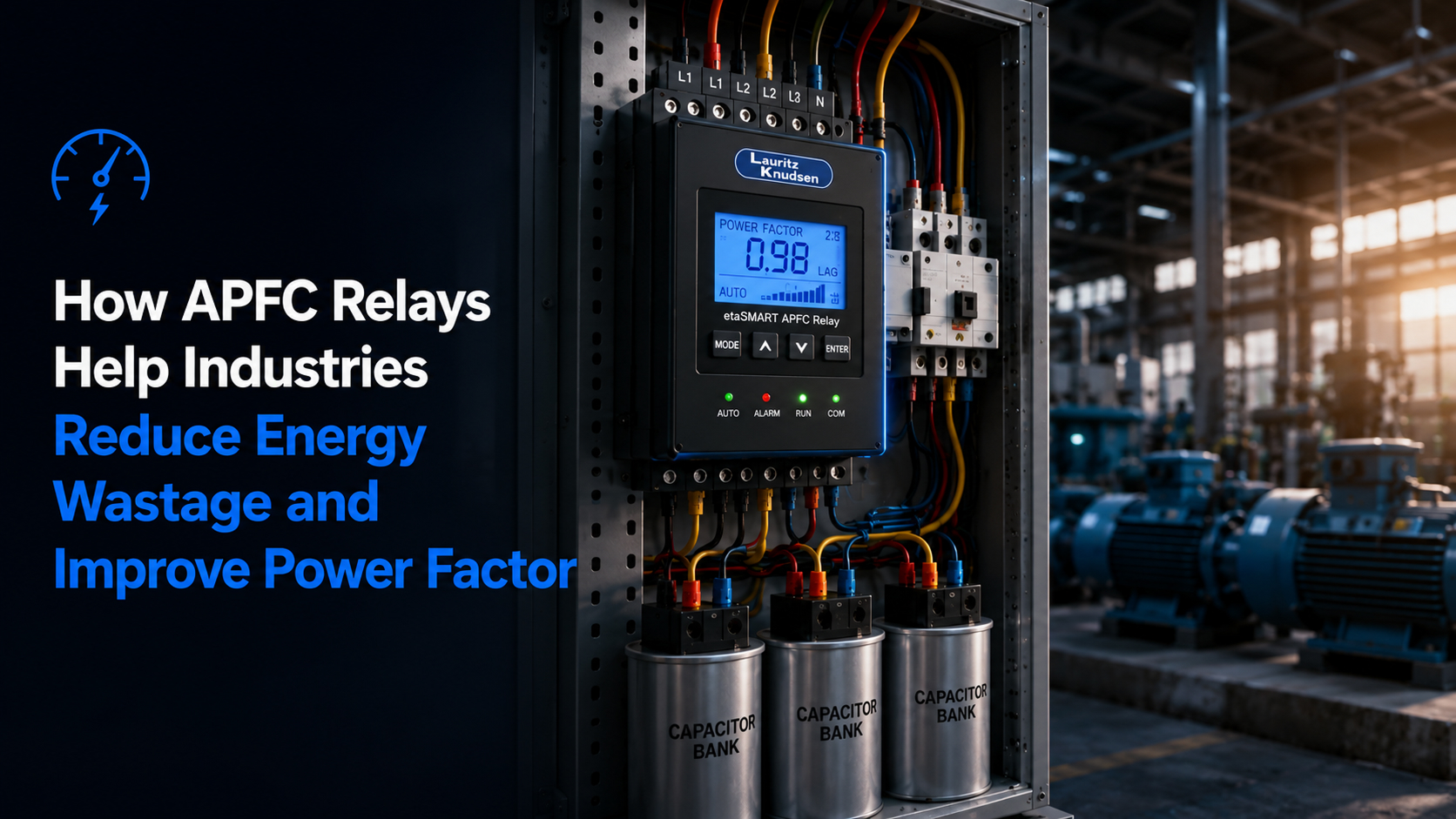
Wastage And Improve Power Factor
Ask any plant manager what keeps operational costs under control, and energy efficiency will almost always be part of the conversation. It makes sense. Electricity powers everything from production lines and compressors to pumps and ventilation systems. But what many businesses don’t immediately see is that not all electrical energy is being used effectively.
A facility can have modern machinery, skilled operators, and a well-maintained electrical network, yet still lose efficiency because of a poor power factor. These hidden losses often increase electricity bills, place extra stress on equipment, and reduce overall system performance.
That is why industries increasingly rely on an APFC relay. By automatically managing capacitor banks and responding to changing load conditions, it helps electrical systems operate more efficiently by reducing reactive power flow, lowering system losses, and improving power factor. While APFC relays do not directly reduce active energy (kWh) consumption, they help minimise I²R losses, optimise apparent power demand (kVA), and improve overall electrical system efficiency and power quality.
What is an APFC Relay?
In simple terms, an automatic power factor control relay is a smart controller that helps electrical systems maintain an efficient power factor automatically. Instead of requiring engineers to manually switch capacitor banks on and off, the relay continuously monitors the system and makes adjustments whenever needed.
Think about a manufacturing plant where dozens of motors start and stop throughout the day. The electrical demand keeps changing. Without automatic correction, the power factor can fluctuate significantly, leading to energy losses and possible utility penalties.
In systems supplying non-linear loads such as variable frequency drives (VFDs), UPS systems, or other power electronic equipment, power factor is influenced not only by phase displacement but also by harmonic distortion. In such cases, true power factor differs from displacement power factor, and achieving optimal performance may require more than capacitor-based correction alone.
This is where the relay becomes important. It measures electrical parameters, evaluates reactive power requirements, and controls capacitor bank switching accordingly. Modern controllers such as Lauritz Knudsen’s etaSMART and etaULTRA APFC controllers offer advanced monitoring, intelligent switching logic, communication capabilities, and reliable operation across a wide range of industrial applications. Their role is not simply to control capacitors but to help create a more efficient and stable electrical system.
APFC Relay Working Principle
Understanding how these controllers function helps explain why they have become a standard component in many industrial power systems. The process is largely automatic, but there is quite a bit of intelligent decision-making happening in the background.
Monitoring the Electrical Network
The APFC relay working principle begins with continuous monitoring of voltage, current, and power factor values. Through connected current transformers, the relay receives real-time information about the electrical system. It constantly compares actual operating conditions with preset targets. Whenever it detects a reduction in power factor, the relay prepares corrective action to restore efficiency and maintain balanced operation.
Automatic Capacitor Bank Control
Once the relay identifies a need for compensation, it automatically switches capacitor stages into the circuit. If demand decreases, it removes unnecessary capacitor banks. This process happens continuously throughout the day. The objective is simple: provide the right amount of reactive power compensation at the right time without causing overcorrection or unnecessary switching cycles. Proper capacitor step sizing and bank configuration are equally important, as they enable accurate compensation while avoiding excessive switching and maintaining stable system operation.
Adapting to Changing Loads
Industrial environments rarely operate under fixed load conditions. Production schedules change, machinery cycles vary, and electrical demand shifts throughout the day. The relay continuously adapts to these changes. Instead of relying on fixed correction settings, it responds dynamically to actual system requirements, helping maintain consistent power factor improvement even when operating conditions are constantly changing.
Frequent capacitor switching can generate inrush currents and transient effects. These are typically managed through appropriate system design, including detuned reactors, zero-cross switching devices, or thyristor-based APFC systems where fast and frequent switching is required.
Applications of APFC Relays
From manufacturing facilities to commercial infrastructure, APFC controllers are used wherever reactive power management is necessary. Their flexibility makes them suitable for a wide range of electrical systems.
Manufacturing and Process Industries
Factories often operate heavy-duty motors, conveyors, compressors, and processing equipment. These inductive loads can significantly affect electrical efficiency. APFC controllers help maintain stable operating conditions by managing capacitor banks automatically. This reduces energy losses, improves electrical performance, and supports smoother production without requiring constant manual adjustments.
Commercial and Institutional Buildings
Large office complexes, hospitals, shopping centres, and educational institutions depend on extensive electrical infrastructure. Air-conditioning systems, elevators, pumps, and lighting networks all contribute to reactive power demand. APFC controllers help maintain efficient operation across these facilities while supporting lower operating costs and better utilisation of available electrical capacity.
Distribution Panels and Utility Systems
Electrical distribution systems often require reliable industrial power factor correction to maintain performance under varying load conditions. APFC controllers installed within distribution panels help improve network efficiency, support power quality objectives, and ensure capacitor banks operate effectively. Advanced solutions also provide communication and monitoring functions that simplify maintenance and system management.
How APFC Relay Helps Industries Reduce Energy Wastage
Energy wastage is not always visible. In many cases, it develops gradually through inefficient electrical operation. APFC controllers help address these issues before they become expensive problems.
Reducing Unnecessary Current Flow
When reactive power demand increases, electrical systems must carry additional current. This extra current creates losses in cables, transformers, and switchgear. By compensating reactive power requirements automatically, the relay helps reduce overall current flow and minimises losses throughout the electrical network. By compensating reactive power requirements automatically, the relay helps reduce overall current flow and minimises losses throughout the electrical network. Although this does not significantly reduce active energy consumption, it lowers I²R losses, decreases transformer and cable loading, and improves overall system efficiency.
Improving Capacitor Bank Efficiency
Capacitor banks are effective only when they operate correctly. If too many capacitors are connected, overcompensation may occur. If too few are connected, correction becomes insufficient. APFC controllers ensure capacitor stages are switched accurately according to actual demand. This improves compensation effectiveness while helping equipment operate more efficiently.
Lowering Utility Penalties
Many utilities impose additional charges on facilities operating with poor power factor levels. A properly configured power factor correction device helps maintain acceptable power factor values and reduces the risk of penalty charges. For large industrial operations, avoiding these costs can make a noticeable difference to monthly electricity expenses.
How APFC Relays Improve Power Factor
Maintaining an efficient power factor is an ongoing process. Electrical loads change constantly, which is why automatic correction plays such an important role in modern facilities.
Providing Reactive Power Compensation
The most direct answer to how APFC relays improve power factor lies in their ability to control capacitor banks intelligently. Capacitors generate reactive power that offsets the reactive demand created by inductive loads. By balancing these requirements, the relay helps bring the power factor closer to ideal operating levels.
Maintaining Consistent Performance
Electrical systems rarely remain stable for long periods. New equipment starts, production loads fluctuate, and operating conditions change. APFC controllers continuously adjust compensation levels to match real-world demand. This ongoing correction contributes significantly to long-term power factor improvement and helps maintain system efficiency.
Preventing Overcorrection Problems
Correcting power factor is important, but excessive correction can create its own challenges. Overcompensation may lead to voltage issues and inefficient operation. APFC controllers prevent this by carefully calculating compensation requirements before switching capacitor stages. The result is a more balanced and reliable electrical performance.
Supporting Better Power Quality
When discussing how APFC relays improve power factor, power quality cannot be ignored. Advanced controllers such as Lauritz Knudsen’s etaULTRA offer harmonic monitoring and sophisticated optimisation functions. However, while APFC relays can measure and monitor harmonic levels, mitigating harmonics typically requires additional equipment such as detuned reactors or harmonic filters. These components work alongside the APFC system to maintain reliable operation in installations with significant non-linear loads.
Conclusion
An APFC relay helps address these challenges by automatically managing capacitor banks, reducing reactive power flow, lowering electrical losses, and supporting stable system performance. Although it does not directly reduce active energy consumption, it improves power factor, optimises electrical capacity, and contributes to more efficient operation of the overall power distribution system. Whether installed in a manufacturing plant, commercial building, or distribution network, it plays an important role in modern energy management strategies.
For organisations seeking reliable industrial power factor correction solutions, Lauritz Knudsen Electrical & Automation offers advanced products such as the etaSMART and etaULTRA APFC controllers. These intelligent solutions combine accurate monitoring, dependable switching, and modern control capabilities to help industries achieve better efficiency, improved power quality, and long-term operational savings.

